

Horses, Hope & Hustle Podcast
Some businesses start with a five-year plan and a pitch deck. Donna Sedoris’s started with a sore mare named Miss Fancy, a registered nurse with no intention of leaving her career, and a problem that nobody else was solving. Twenty-five years later, CSI Saddle Pads is a name trusted across the western performance world — and the story of how it got there is one of the best examples of what it actually takes to build something real in this industry.
The Horse That Started It All for CSI Saddle Pads
Donna wasn’t trying to start a company. She was a registered nurse working in the ER, riding competitive trail with her mare, Miss Fancy — 15 to 17 miles a day through Missouri humidity. Fancy had a big heart and would do anything, but she was particular. If something was wrong, she’d tolerate it for two or three days and then she’d let you know.
“We had a lot of arguments over the course of, you know, until I figured out what the problem was. It wasn’t just her and I PMSing together. There was actually a reason.”
That reason was saddle fit. Donna bought every pad on the market, and none of them held up to the mileage she was putting in. So she started experimenting — taking cues from a cutting horse mentor named Jim Watson. That idea — taking pressure from one small point and spreading it across a bigger footprint — became the foundation of the flex plate that still defines CSI Saddle Pads today.
It took about three years of trial and error to land on a design that worked. Donna officially became an LLC in 2001. She had no intention of becoming a saddle pad manufacturer. She just wanted her horse to stop hurting.
Word Got Out the Old-Fashioned Way
Word spread through results other people could see. Donna used to travel with a backup horse so Fancy could rest her sore topline every third day. Once the CSI Saddle Pad started working, that need disappeared, and her trail riding friends noticed.
“They would be like, what’s different? Why isn’t your horse bucking you off?”
That question, repeated by enough people, planted the idea that this wasn’t just a fix for one mare. A chance conversation with a friend at a paint horse event — who told her flatly, “this is the bomb, you need to do something with this” — pushed her toward turning it into a real business.
CSI Saddle Pads Are Made in America — and That’s Non-Negotiable
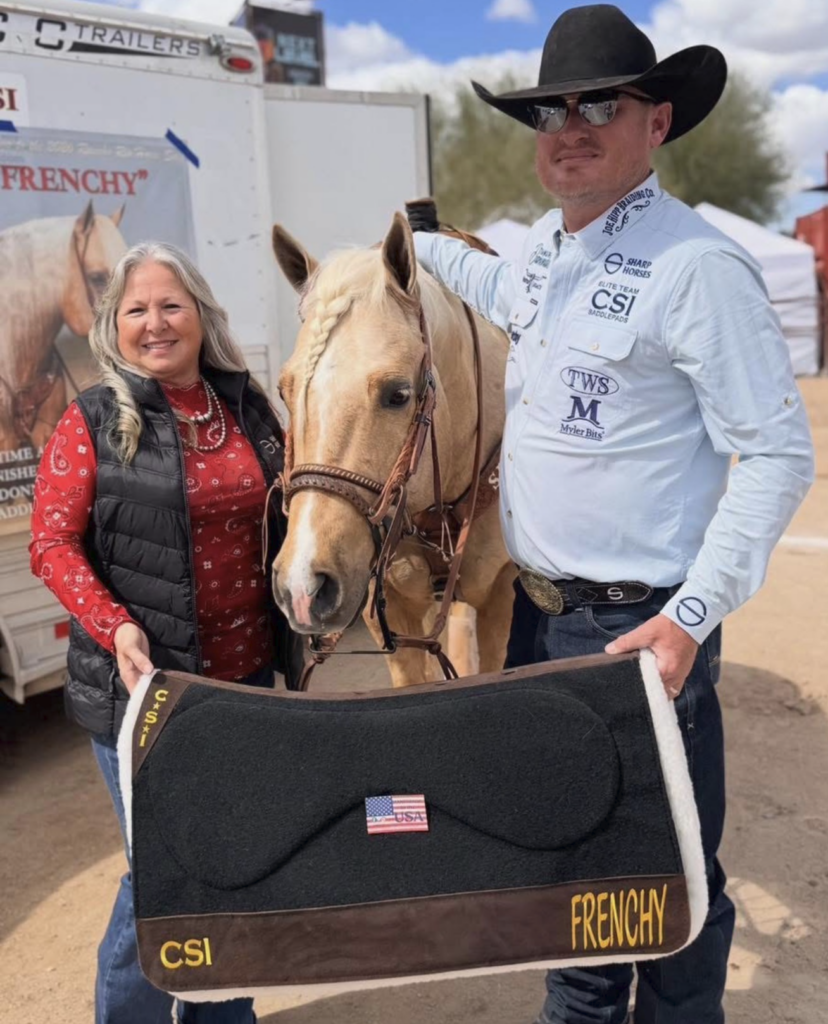
Around 2005, Donna went all in. She quit holding back and hit the road hard — driving coast to coast, doing horse expos out of pickup trucks, putting her face and her product in front of people because this is still a tactile industry. People want to touch and feel what they’re buying.
She made one decision early on that she has never wavered from: every material, every hand on the line, stays in America. That decision wasn’t popular at the time. She remembers a competitor at a buckskin world championship event flatly telling her she wouldn’t survive five years if she didn’t manufacture overseas like everyone else was doing.
“He said, ‘You won’t survive five years if you don’t.’ And I’m like, okay. You’re like 25 years later, dude.”
Yes, the price gap between American and overseas manufacturing is real, and not everyone can afford a CSI pad. But those pads outlast everything else you’ll put on your horse’s back — and Donna has the receipts. Pads still being ridden today at 23, 24, 25 years old.
From a Living Room Floor to a 10,000 Square Foot Plant
The early days were about as unglamorous as it gets. Donna and her then-husband built CSI Saddle Pads on their living room floor — kneeling and crawling across rolls of material, cutting everything by hand with box knives. She still carries the damage in her hands from those years.
From there, they rented a small facility, hired a seamstress, and celebrated making three pads a day like it was a milestone — because it was. The business grew in stages, adding onto the plant four or five times over the years as demand and finances allowed.
“I’ve really tried to… I know in business you’re not supposed to pay as you go, you’re supposed to borrow as you go. Kind of goes against my upbringing.”
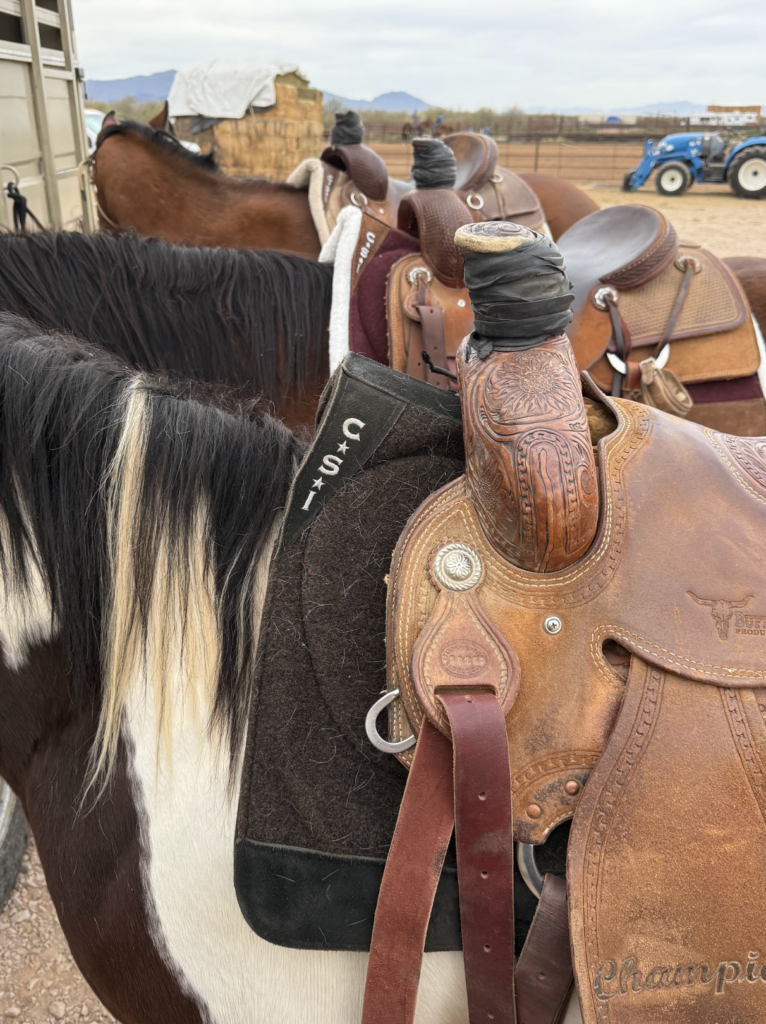
Today the plant runs in two distinct sections: a dirty side where raw materials are die-cut using 50 and 100-ton presses, and a clean side where the sewing happens. Every CSI Saddle Pad passes through roughly 32 steps and around six to seven hours of labor before it’s finished. Every employee initials the pad they sewed. Every station self-checks the work before passing it down the line. It’s a quality control system built on personal accountability.
What the CSI Saddle Pad Flex Plate Actually Does
Donna compares the flex plate to a shoehorn. Just like a shoehorn protects the back of a dress shoe from being crushed when you slide your foot in, the flex plate sits between a horse’s shoulder blade and the saddle tree — two hard surfaces, one bony and one wooden — and allows the shoulder to glide forward, backward, and side to side without being pinned or restricted.
Donna uses a homemade pressure tester at trade shows she jokingly calls “the redneck pressure test machine.” Push down on a section of a competitor’s pad, and most max out around 50 to 60 pounds of pressure tolerance before your hand feels it. Push down on a CSI flex plate, and it takes 300 to 400 pounds before that same pressure registers. That’s the whole philosophy in one demonstration: distribute the weight, don’t just cushion it.
The Coleman Proctor Story
Years ago, top header Coleman Proctor toured the CSI Saddle Pads plant and sat down to try sewing a pad himself under the supervision of sewing supervisor Amy. The needle on that industrial machine is large enough that breaking one sounds like a gunshot. Coleman hit the gas pedal, the machine took off faster than he expected, and by the time he finished his section, leather scraps were scattered everywhere. He stood up and told the room: “Ladies, I think I’m going to stick to roping.”
That’s the reaction Donna wants people to have — not to prove a point, but because once you understand what actually goes into one of these pads, the price makes sense. And once people understand the why, the sales pitch disappears entirely.
When a Single CSI Saddle Pad Fitting Changed Everything
My stud horse had been losing his stop — walking through it instead of sitting down, which cost him his hind end in the maneuver. I was beyond frustrated, certain the horse could do it and unable to figure out why he wasn’t. One pad fitting with Donna at Rancho Rio later, everything changed. The saddle tree pressure had been radiating straight into his shoulders, and his only way to escape that pressure was to walk through the stop instead of sitting into it.
“Usually if the horse has developed a problem, check your equipment because something has changed.”
That one adjustment was the entire fix. No retraining, no extra months with a trainer — just the right CSI Saddle Pad doing what it was supposed to do.
Why CSI Saddle Pads Matter for Young Horses Especially
If a young horse’s earliest associations with stopping, turning, or any maneuver involve pain, that pain becomes wired into how they perform that movement for the rest of their life. Fix the pain early, and you remove an entire obstacle from their training before it has the chance to become a habit.
“If we can shorten that training time even by three weeks, that’s almost a month of your training bill right there.”
Donna fits her own colts in training with CSI Saddle Pads before anything else happens, specifically because horses that aren’t distracted by back pain are horses that are actually listening to their rider’s cues.
Twenty-Five Years Built on Faith and Grit
Donna’s path to CSI Saddle Pads was natural, hard, and full of sacrifice. She came up through nursing and paramedic work before transitioning fully into the business. She built this company in the years following a divorce — starting essentially from scratch, the same as so many women in this industry have had to do.
Her advice to anyone with an idea they’re nervous to chase: “Hold your cards close, especially if it’s something that’s patentable. You got to put forth the effort. You got to give God the glory. And work hard.”
Her stepdad once told her that surviving one year in business meant something. Surviving two meant you were good. Surviving five meant you were going to be okay. CSI Saddle Pads just passed twenty-five.
The Legacy Behind CSI Saddle Pads Continues
Donna’s granddaughter is preparing to take over the company as Donna eventually steps back — and the family thread runs deep. As a child, that same granddaughter used to tie leather crosses for the business at a penny apiece. Now her own two-year-old comes to work with his parents, pushing a little janitorial cart around the shop, helping sweep.
It’s a small detail, but it says everything about what CSI Saddle Pads actually is: not just a saddle pad company, but a family business built one generation at a time, on a foundation that took blisters, sacrifice, and twenty-five years of staying the course to build.
Where to Find Donna Sedoris and CSI Saddle Pads
Website: csipads.com — send photos of your horse for a remote fitting consultation. Find Donna and the CSI Saddle Pads trailer at major events throughout the year, including the timed event in Guthrie, the NTR Finals, the BFI, and stops across her East Coast tour. Follow along on Facebook and Instagram — the account has over 110,000 followers and is managed by Bailey Bowers.
Donna’s story is exactly why we started this podcast — to show the real cost and the real reward of building something in this industry. Quality doesn’t happen by accident, and neither does a quarter century in business. This episode of Horses, Hope and Hustle is available now wherever you listen to podcasts. Share it with someone who needs the reminder that anything worth having is not easy — but it is possible.
Stay true. Stay tough. Keep hustling.
Author: Crystal Show
share to
most popular posts